IRCAS

A Novel End-to-End Approach to Identify, Rectify and Classify Comprehensive Alternative Splicing Events Without Genome Reference

Revolutionizing alternative splicing analysis for non-model organisms with unprecedented accuracy and efficiency.

Key Features
  • Reference-free AS detection
  • End-to-end accuracy: 83.4%
  • Hybrid GNN architecture
  • Multi-species support
  • Open source

What is IRCAS?

IRCAS is an integrated end-to-end framework for reference-free alternative splicing analysis, addressing fundamental limitations that have constrained previous methodologies in non-model organisms.

Identification

Employ colored de Bruijn graphs for accurate AS detection without reference genome dependency.

Rectification

Attention-based CNN model for precise splice site correction (92-96% accuracy).

Classification

Hybrid Graph Neural Network combining GAT and Transformer layers for robust AS type classification.

Methodology

IRCAS integrates three complementary modules into a seamless end-to-end pipeline.

Step 1: Reference-Free AS Identification

Initial screening using BLAST for pairwise alignment, followed by mixed k-mer colored de Bruijn graph construction to detect topological "bubbles" representing AS events.

  • BLAST all-versus-all alignment for preliminary screening
  • cDBG construction with specified k-mer size
  • Bubble topology classification into 5 types

Step 2: AS Position Offset Rectification

Attention-based convolutional neural network (CNN) rectification model trained to predict offset between predicted and true splicing sites.

  • Virtual nucleotides denoting splicing start/end sites
  • One-hot encoding into n×6 vectors
  • Multi-scale CNN with self-attention mechanism
  • Huber loss for robust optimization

Step 3: AS Event Classification

Hybrid Graph Neural Network architecture combining Graph Attention Networks (GAT) and Transformer layers for high-precision classification of four AS event types.

  • Node, edge, and global feature extraction
  • Dual-layer encoder with GELU activation
  • Hybrid loss function addressing class imbalance
  • Transfer learning for cross-species generalization
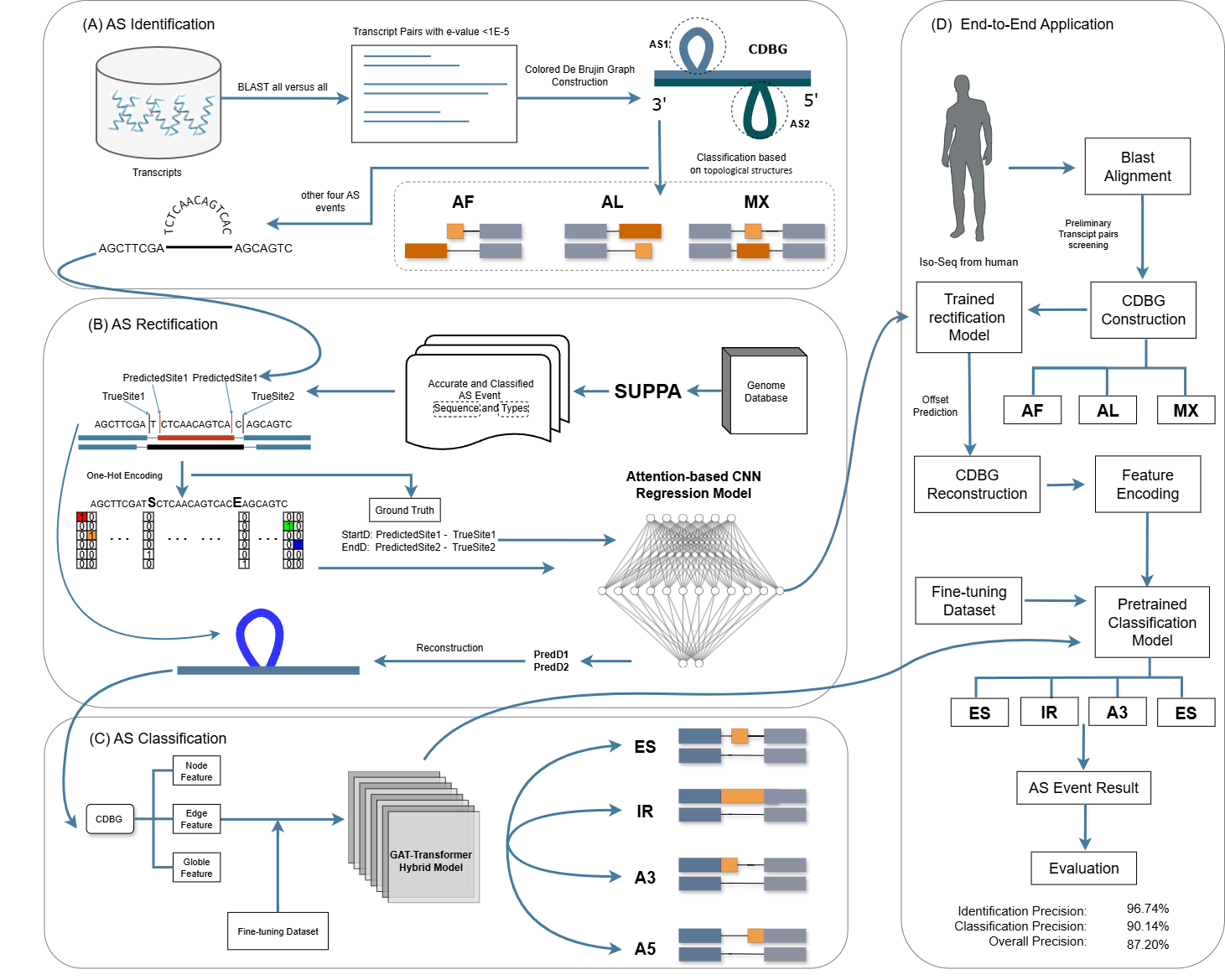
IRCAS Workflow

Fig 1. Workflow for construction and application of IRCAS

Performance Benchmarks

IRCAS demonstrates substantial improvements over existing methods across multiple species.

92-96%
Splice Site Accuracy

vs 50-55% for existing methods

83.4%
End-to-End Accuracy

vs 41.2% for previous best method

4
Species Tested

Human, Mouse, Arabidopsis, Rice

7
AS Types Classified

ES, A3, A5, IR, AF, AL, MX

Comparative Analysis

Method Human Arabidopsis Rice Mouse
AStrap 68.6% 83.5% 84.4% 69.4%
DeepASmRNA 87.5% 90.7% 89.2% 88.2%
MkcDBGAS 88.9% 91.1% 90.2% 87.3%
MCTASmRNA 55.3% 34.5% 32.4% 53.7%
IRCAS 90.1% 92.8% 91.9% 91.8%

Table: Overall classification accuracy (%) across four species

Citation

Shen C, Zhang Q, Cao Q, Liu X, Zhang Z, Li B, Zhang R. IRCAS: a novel end-to-end approach to identify, rectify and classify comprehensive alternative splicing events in a transcriptome without genome reference. Nucleic Acids Research. 2026.